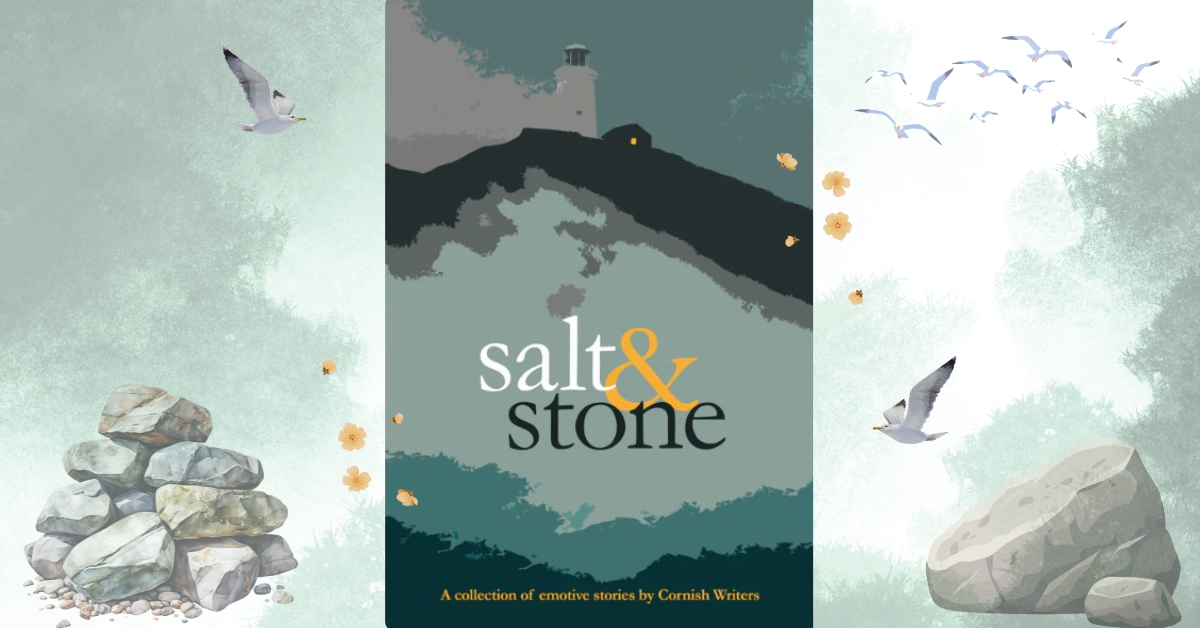
Soon, my short story Saltwater Grounding will be published by Hermitage Press in the forthcoming Cornish anthology Salt & Stone, a collection celebrating stories shaped by Cornwall’s landscapes, communities, and quiet resilience. The anthology launches this May at the Cornish Indie Book Festival, alongside a group of incredibly talented writers exploring what it means to endure through place, weather, memory, and change.
Writing through the disorientation of menopause
Saltwater Grounding grew from personal inspiration and from my wider interest in writing women’s stories that reflect the realities many experience. In recent years, I’ve been navigating perimenopause – a time that can quietly, and sometimes shockingly, alter how women experience themselves.
This story grew from deeply personal inspiration and from my wider interest in writing women’s stories that reflect the realities many experience.
Mood shifts, cognitive fog, and emotional intensity are not uncommon. Yet many women reach this stage of life without fully understanding what is happening to them.
In the UK, around 13 million women are currently perimenopausal or menopausal, and studies suggest that up to 60% experience anxiety or mood changes during this transition. Yet the emotional dimension of this life stage is still under-spoken about in everyday culture.
Some trailblazers are changing that; thank all the Gods for Dr Mindy Peltz, Dr Jen Gunter, Dr Mary Claire Haver, Dr Louise Newson, Dr Lisa Misconi, Dr Julie Smith, Davina McCall, Petra Coveney, and many others beyond my current and immediate orbit who are bringing light to this subject and that of female identity.
What has struck me most so far is the sense of internal unfamiliarity. A feeling of standing slightly outside yourself.
In Saltwater Grounding, the protagonist Merryn, experiences something similar. At one point, she reflects that she no longer recognises herself, describing the emptiness and the loss of pleasure or connection to things once loved. That state of dislocation became the story’s starting point.
For many writers, this stage of life can also become fertile ground for women’s fiction inspiration, because it forces us to reconsider who we are and how we tell our stories.
For many writers, this stage of life can also become fertile ground for women’s fiction inspiration, because it forces us to reconsider who we are and how we tell our stories.
The quiet realities of domestic abuse
Alongside this personal inspiration was another, much harder truth. Domestic abuse remains far more common than many people may realise. According to the Office for National Statistics, around one in four women in England and Wales will experience domestic abuse in their lifetime. Millions of cases occur each year, yet many never reach the courts or public attention.
Abuse is not always loud and heard through walls. Sometimes it exists in the slow erosion of a person’s confidence, identity, and emotional stability.
In Merryn’s story, the breakdown of her marriage includes moments of violence and control, which push her to leave London and return to Cornwall to rebuild her life. Writing about domestic abuse in fiction can be difficult, but stories like these help illuminate experiences that remain hidden in many lives.
In keeping with the tropes of women’s fiction, I wanted to show the quiet aftermath – the rebuilding, uncertainty, and slow rediscovery of self. Life in Cornwall is perfect for this. The seasons and the vistas became the landscape where this recovery can unfold.
The coastlines, woodland paths, and shifting weather mirror Merryn’s internal journey. There’s a precipice early in the story where she contemplates ending her life, but it’s also a place where she begins to understand the consequences of that thought and turns back toward connection.
In Cornwall short stories, the place itself can become a character.
Cold sea swims, woodland walks, and the quiet companionship of neighbours are what start to anchor her again.
Why women’s stories will always matter in literature
We’re living in a time where conversations about gender can feel increasingly polarised, or prejudiced, whatever your gender identity. Public discourse can be loud, defensive, and adversarial, especially on social media – but storytelling allows something different. Fiction offers space for nuance, complexity, and empathy. It allows us to sit inside a character’s interior life and experience what it means to inhabit their reality.
As a developmental editor working with women fiction writers, this is the part of storytelling that inspires me most: helping them shape narratives that bring overlooked experiences into the light. Many midlife women’s stories – of recovery, stories of quiet resilience – I believe are still underrepresented in literature, yet these are precisely the stories in which many women recognise themselves.
Powerful stories can begin in places that feel uncertain or uncomfortable. Sometimes they begin on the edge of a cliff, then turn their back toward the sea.
The anthology Salt & Stone will be published in late April, with a launch at the Cornish Indie Book Festival on 16 May.
You can pre-order a copy now through the publisher, Hermitage Press.
I’m honoured that Merryn’s story will sit among such a strong group of Cornish writers exploring the theme of adversity from different perspectives.
-
The story behind Saltwater Grounding, a Cornwall short story inspired by perimenopause, women’s resilience, and the need to tell stories that often go unheard. Featuring in an anthology by Hermitage Press called Salt and Stone, it launches this May at the Cornish Indie Book Festival.
A clear, compelling premise and narrative question help novels shine. Learn how a developmental editor can help you find them and shape your story.
Explore the difference between plotters and pantsers—featuring writing tips, author insights, and tools to help your story take shape.